
Moving beyond the annual spreadsheet exercise
This is part 3 of a series on IT Financial Management (ITFM). The series explores IT cost transparency, showback and chargeback, modern budgeting and forecasting, managing value through benchmarks and KPIs, freeing up budget for innovation, and building a mature ITFM organization as a source of competitive advantage.
“As a CFO or IT Finance Manager, I often struggle to explain IT budgets to the business.”
“Our IT budget turns into a cumbersome spreadsheet exercise every year. By midyear, it no longer reflects reality.”
If this sounds familiar, the issue lies not with the budget itself but with the process behind it. A budget is established at a specific point in time, while IT demand, business priorities, and delivery plans continue to evolve.
The first article in this series addressed a fundamental question: where is IT spend going? The second article focused on who uses IT services and who should be accountable for the cost. The next challenge is to leverage those insights to effectively manage the budget and forecast throughout the year.
“Start small. Link the usage of a single service to its costs and include that in the next quarterly review. Then it suddenly feels different from just a deviation in an Excel spreadsheet.”

When the budget no longer reflects reality
For many organizations, the budget cycle starts in autumn with a large Excel workbook. Teams take last year’s figures, apply a percentage uplift or a reduction, and send their input back to IT and finance. Weeks are spent collecting data, consolidating versions, and revising assumptions.
These assumptions are often fragile from the outset. Information about demand arrives late or in fragments. Projects are delayed or reprioritized, and cloud usage fluctuates. Yet the budget is fixed at a certain point in time, even though the conditions behind it continue to evolve. By the time a variance becomes visible, it is often too late to take meaningful action.
The outcome is familiar: recurring overspending and underspending, difficult conversations between the CFO and CIO, and business leaders who perceive IT budgets as mere numbers imposed on them rather than the financial consequence of their own plans. The CFO asks what has changed, and the CIO can only provide an estimate. Neither has a reliable view of the remainder of the year.
At Eraneos, we frequently observe this pattern. In the first quarter, the budget may still align with the plan. However, as time progresses, priorities shift, projects change, and service demand evolves in unexpected ways.
Change itself is not the problem. The challenge is losing sight of the assumptions behind the budget and understanding what those changes imply for the forecast. CFOs and CIOs end up spending too much of the year explaining past performance rather than actively managing future possibilities. Budgeting transforms into an exercise in variance reporting rather than a tool for facilitating better decision making.
Can it still work?
A growing share of IT costs now moves with demand. Cloud services, SaaS subscriptions ,and external capacity do not behave like fixed annual cost lines. A budget set once a year is insufficient in an environment where consumption changes month by month.
The way organizations operate has changed as well. Teams work across products and value streams, with priorities evolving throughout the year. Finance needs predictability and control, while IT needs flexibility to respond to changing demand. Without a clear connection between business plans, service usage, and cost, those needs will remain in tension.
This is where the foundations laid in the first two articles come into play. Without cost transparency and showback, the IT budget remains a single number. It does not show the services, users, volumes, or decisions behind it.
Featured Infographic
ITFM in 2 minuten
Missen organisaties inzicht in IT-kosten? Het TBM Framework van Eraneos brengt structuur. Download onze infographic en ontdek hoe IT groeit.
Read more about this infographic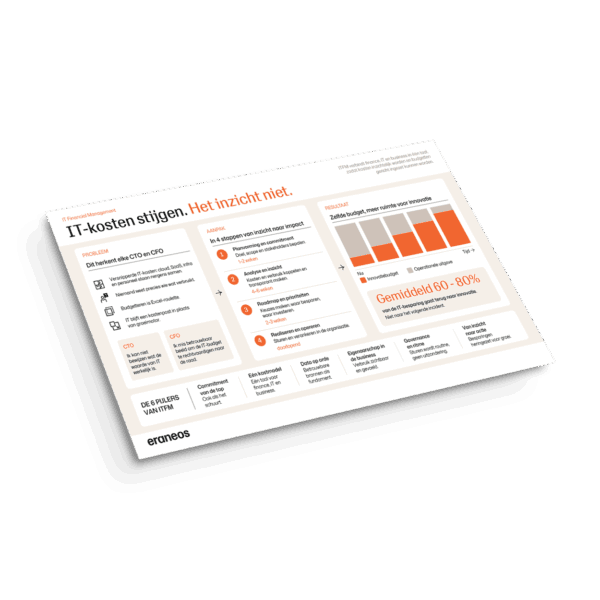
What modern budgeting and forecasting changes
Modern budgeting does not mean abandoning financial discipline. Instead, it involves making budgets and forecasts more accurately reflect how IT is actually consumed and managed.
A shared view. Finance, IT, and the business should not discuss the budget as an isolated figure. They need to see which services are required, what drives their cost, and how expected demand is changing.
Based on cost drivers. Link costs to the factors that drive them, such as active users, transactions, environments, licenses, or projects. A growing team then has a visible impact on workplace costs, while retiring an application clearly affects future spending.
Iterative forecasting. Forecasting should become a regular management activity. Instead of relying solely on the annual budget cycle, review the forecast periodically. Compare the budget with actuals, assess changes in demand and plans, and update the outlook as needed.
Clear roles. IT provides insight into services, capacity, and delivery scenarios. Finance maintains financial control and connects the forecast to broader planning. The business offers visibility into upcoming changes in demand. All three work from the same underlying figures.
Building a repeatable process
Start with the cost and service-use data established through cost transparency and showback. Costs should already be organized by service, application ,and business area. Showback needs to clarify which business units utilize those services.
From there, develop simple models around the main cost drivers. For example:
Digital workplace cost = number of active users x cost per user
CRM license cost = number of active licenses x license price
The goal is not to model every euro with absolute precision, but to clarify the relationship between demand and cost sufficiently to support decision-making. Leaders should understand what business growth, decreased demand, or the retirement of an application means for the forecast.
Incorporate these models into the management cycle. During quarterly reviews, IT, finance, and the business should collectively consider actual spend, service usage and upcoming changes. Agree in advance on when the forecast will be refreshed, what triggers an update and who will be involved.
The process should align with existing portfolio and planning cycles, not operate independently. Budget, forecast, and demand need to be discussed together, with clear ownership for maintaining the process.
Introduce the approach in stages. Begin with one service, such as the digital workplace. Track active users, connect that data to costs and bring the forecast impact into the next review. This is often where the value becomes visible quickly: a change in workforce size can be translated into an updated cost outlook before it results in an unexplained year-end variance. The nature of discussion changes as well. Instead of debating a line in a spreadsheet, leaders can discuss what changing demand means for the upcoming quarter and the options available to them. The model can then be expanded to include licenses, applications and cloud services.
What it delivers
At Eraneos, we observe that organizations using shorter, driver-based forecasting cycles spend less time reconciling budget figures and more time discussing the decisions behind them. There are fewer manual budget rounds, fewer last-minute corrections and less effort expended on consolidating different versions of the numbers. The same data supports transparency, showback, budgeting ,and forecasting.
More importantly, the quality of the conversation improves. The focus shifts from justifying why the budget no longer aligns with reality to determining actionable next steps. IT can articulate the financial implications of changing service demand. Finance can evaluate the impact on the broader outlook. Business leaders can understand how their plans affect the IT budget. This clarity also facilitates discussions about why a certain level of IT funding is necessary and what would change if demand, scope, or priorities were to shift.
The transition requires investment. The organization needs a reliable cost and consumption model, and IT, finance, and the business must become comfortable working with cost drivers and regular forecast updates. For a period, the annual budget process and the new approach may need to operate concurrently. Adapting to the new process takes time.
What does this mean for you?
Ask yourself three questions:
- How confident are you in your current IT budget and forecast?
- Halfway through the year, can you clearly explain why you are on track or off track based on changes in business demand and decisions?
- Can you articulate to the business why a particular level of IT funding is necessary to support its plans?
If your answers depend on estimates or a series of calls to piece the story together, do not start by revising the numbers. Instead, begin by reviewing the budgeting process. It may no longer accurately reflect how IT and the business operate today.
Next in this series
The next article will focus on managing IT for value through benchmarks and KPIs: how to demonstrate that IT is more than just a cost and how to effectively manage its contribution in practice.