AI transformation rarely fails because the technology underperforms. It fails because workflows, responsibilities, and routines stay the same. Real value appears only when people know when to use AI, how to use it safely, and how it could impact their role. That is when AI moves from experiment to execution.
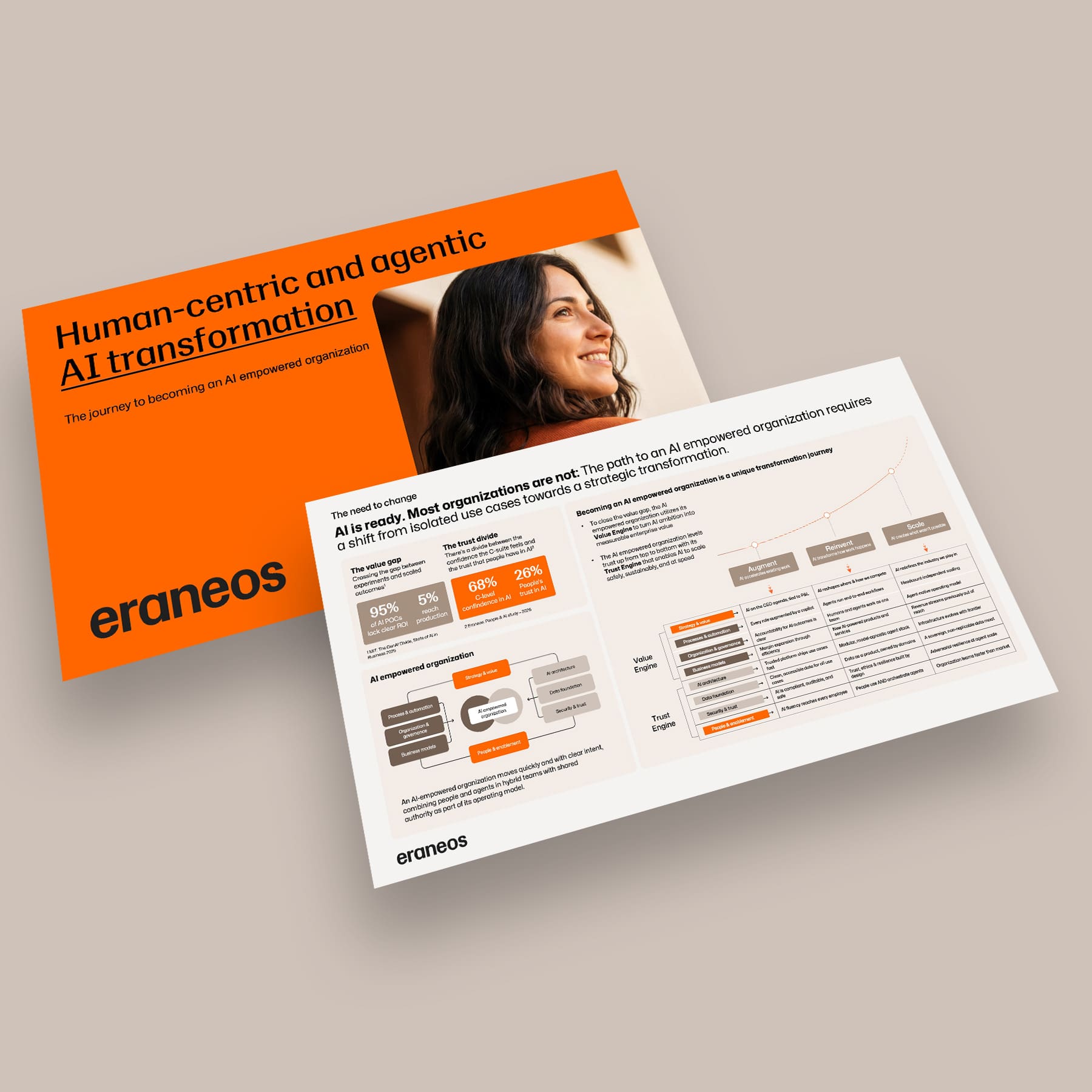
According to the World Economic Forum This link opens in a new tab, a recent MIT Media Lab report found that, despite the majority of organizations using AI in some form, 95% of them currently see no measurable return. For many organizations, the transition from AI hype to tangible benefits is still underway.
2.52 trillion
95 %
31 %
Recently, Eraneos supported two financial services organizations, a major insurer and an innovative fintech, that had already moved past the question of whether AI mattered. Their real challenge was harder: how to embed AI into everyday work in a way that people could trust, use, and scale. Their experience offers a clear view of why AI transformation so often stalls, and what organizations need to change to make it stick.
A lesson in trust: Transitioning from skepticism to success
During our collaboration with a global insurance company, we encountered a common hurdle: technical skepticism. High-level IT professionals were wary of adding yet more generic tools to their tech stack. When an initial AI platform failed to deliver real-world value for senior developers, adoption stalled.
We realized that in a technical organization, you don’t simply roll out AI – you enable it. As part of the overall strategy, we therefore implemented a GenAI coaching model alongside the planned tool development. By pivoting to a Train the Trainer model, we empowered a growing network of AI ambassadors across different business units to build their own agentic workflows. We didn’t give them a mandate. We gave them autonomy and helped them improve and scale it.
This matters more than many organizations realize. A recent survey This link opens in a new tab found that just 31% of workers say their employer provided training on AI tools. Our project demonstrated the importance of a bottom-up, co-creation approach. After all, AI won’t supercharge productivity if there’s a disconnect between the technology and the people using it.
Our project demonstrated the importance of a bottom-up, co-creation approach. After all, AI won’t supercharge productivity if there’s a disconnect between the technology and the people using it. With this alternative approach, the platform grew to over a thousand users users, enabled by community townhalls, dedicated training sessions, and various knowledge-sharing formats. On the tooling side, tens of high-impact features were defined and implemented within the platform, supported by a structured development pipeline to sustain ongoing innovation.
Our work also led to a noticeable cultural shift within the organization. The bottom-up enablement approach reduced the risk of shadow AI and fostered a transparent, collaborative community around AI use. This allowed the AI Office to transition from a centralized platform provider to a facilitator of shared learning and best practices.
Grounded in reality: Meeting ambition head-on
At the fintech, the challenge was different. An earlier assessment had identified a large potential in annual cost savings through the use of AI, but lacked a concrete roadmap on how to get there. The assessment was disconnected from the day-to-day processes of several departments and business units, leaving the client with ambition but no clear path forward. This is where Eraneos came in.
For this project, we shifted gears, starting with the introduction of a pragmatic, process-driven AI Design Sprint Framework, during which we analyzed the client’s core business processes to identify, prioritize, and structure AI use cases. The initiative was supported by the client’s AI Unit, and positioned as a strategic transformation across the whole organization.
The result: a 5-year road map with a clearly defined path to realizing over $50 million in savings, with around 30 prioritized use cases in 2026 alone; a figure the client could actually plan and deliver against.
Two routes to reframing AI use
These projects highlight different challenges, but the same underlying issues. Organizations often add AI to existing work rather than redesigning work around it, and that is where return on investment stalls. AI gets treated as a technology initiative rather than a business transformation. The tools fail to fit the real work. And the friction involved in making AI stick – culturally, operationally, technically – is consistently underestimated.
At the insurer, the fix was cultural – building trust from the bottom up through coaching and co-creation. At the fintech, it was structural – anchoring ambitious targets to operational reality through a rigorous roadmap. In both cases, the breakthrough came not from the technology itself, but from how it was connected to the people and processes around it.
AI is everywhere. Value isn't.
We help organizations move beyond experimentation by embedding intelligence into workflows, enabling people, and turning AI into business performance.

From experimentation to economic impact
According to Gartner, worldwide spending on AI is forecast to reach $2.52 trillion in 2026 – a 44% increase year-over-year. Yet many organizations find themselves in a trough of disillusionment, struggling to show that these investments move the needle.
The problem isn’t a lack of tools, it’s a lack of operational maturity. Leaders who see measurable gains focus on workflow redesign and active leadership, not simple tool deployment. At the insurer, we shifted the GenAI Office from platform provider to community moderator. At the fintech, we replaced unfounded estimates with a process-driven design sprint that turned potential into a structured, multi-year transformation program.
How Eraneos can ensure your AI delivers
Successful AI implementation rests on one central truth: productivity gains do not come from plug-and-play solutions, but from process-led evolution. It is people-driven as much as it is technological. And it is about bringing your team along on the journey, equipping them with the right tools, training, and support to make AI work in their daily reality.
Eraneos combines AI technology expertise with proven operational transformation methods into one integrated delivery. We redesign workflows, enable people, and deploy AI in daily operations – end to end. We go beyond strategy and tooling by helping define governance and guardrails, and by tracking operational performance and adoption over time.