Artificial intelligence is no longer just a hype – it is evolving into the operating system of the energy economy. While conferences still debate use cases, a parallel reality is developing in which AI controls grids in real time, orchestrates millions of decentralized installations, and integrates new major consumers like data centers into the system in milliseconds.
At the same time, the pressure is increasing. The worldwide energy demand of data centers and AI applications is expected to double by 2030, while in Europe alone, they could account for up to five percent of electricity consumption. For energy companies, this means that AI is not just a tool for efficiency improvement – AI itself is becoming a driver of new loads, business models, and regulatory questions.
How can AI help in these circumstances? And why is it so difficult for many companies to fully utilize its potential? To answer these questions, we have brought together three perspectives: Professor Dr. Marko Sarstedt This link opens in a new tab from Ludwig Maximillan University, Chair of Marketing and a leading researcher on the “attitude-behavior gap” in data-driven decisions; Claudia Schulze This link opens in a new tab, Global Data & AI Lead at consulting firm Eraneos, which helps energy companies implement AI models in practice; and Felix Schwerin This link opens in a new tab, who is a Managing Director at Eraneos’ strategy unit, and has guided energy providers through transformation for over 20 years.
Many believe in AI – few build their energy systems on it
Question: If AI is becoming so central, why are so many companies still hesitant to implement it?
"We observe an 'Attitude-Behavior Gap 2.0': Strategy papers identify AI as the core of future value creation, but investment decisions are often still guided by last decade’s logic. In ten years, the difference between companies that treat AI as an experiment and those that align their system design with it will be existential – much like the shift from Nokia to smartphone ecosystems."

"Technically, AI will be a commodity in five to ten years. The bottleneck will shift toward data quality, integration capability, and governance. Energy providers who don’t build consistent, domain-oriented data models today will face challenges in 2030 meeting regulatory requirements, autonomous grid management, and new business models simultaneously."

"We see many pilots addressing efficiency improvements at single-digit percentages. However, the real question is: Who has the courage to define a Target Operating Model so that 70 percent of operational decisions will be made with AI support in the future – from grid disposition to customer interaction?"

An energy system will no longer be manageable without AI
Question: Where are the greatest opportunities – and necessities – for AI in the energy system of the 2030s?
Felix Schwerin:
“By the mid-2030s, we will see hundreds of millions of distributed energy producers, storages, and controllable consumers – from PV rooftops and home batteries to electric vehicles operating in vehicle-to-grid mode. The number of possible system states will explode, and traditional planning and dispatching approaches will hit physical and organizational limits. AI-based control won’t be ‘nice to have,’ but a prerequisite to ensuring supply security with a high share of renewables.”
Claudia Schulze:
“In the short term, there will be continued strong effects on forecasts, maintenance, and portfolio management. The next leap will occur as these models move into closed control loops: autonomous grid segments optimizing power flows independently; virtual power plants reacting in real time to market and weather data; operations management dynamically planning maintenance windows based on constantly reevaluated failure probabilities.”
Dr. Marko Sarstedt:
“This will also shift the role of humans. In many control centers and trading departments, work will move from operational decision-making to monitoring, scenario evaluation, and governance. Companies that fail to update their skills sets and training now will face a significant skills gap in ten years.”
Why many AI programs are stuck in the past
Question: Why do many energy companies remain in pilot mode despite the clear data-driven future?
Claudia Schulze:
“Many initiatives followed a classic ‘IT project’ logic: Build a model, demonstrate a business case, and hope the organization adopts it. For an energy system increasingly led by AI, however, we need architecture and investment logic spanning decades – akin to grid expansion. This encompasses data products, machine learning operations (MLOps) platforms, and standardized interfaces that will remain viable in five or ten years.”
Dr. Marko Sarstedt:
“Moreover, as long as AI is understood as an add-on, risk aversion will dominate. Leadership recognizes reputational and regulatory risks but underestimates the risk of inaction.”
Felix Schwerin:
“Breaking free requires consciously committing to a 2030 AI vision: Which portions of grid management will be automated? How will fully digitalized customer interaction work? Which areas of asset lifecycle management will be governed by predictive models? From there, companies derive roadmaps, capex plans, and organizational designs – treating AI not as an innovation budget but as a core component of the infrastructure strategy. This shifts the planning horizon well beyond the next pilot.”
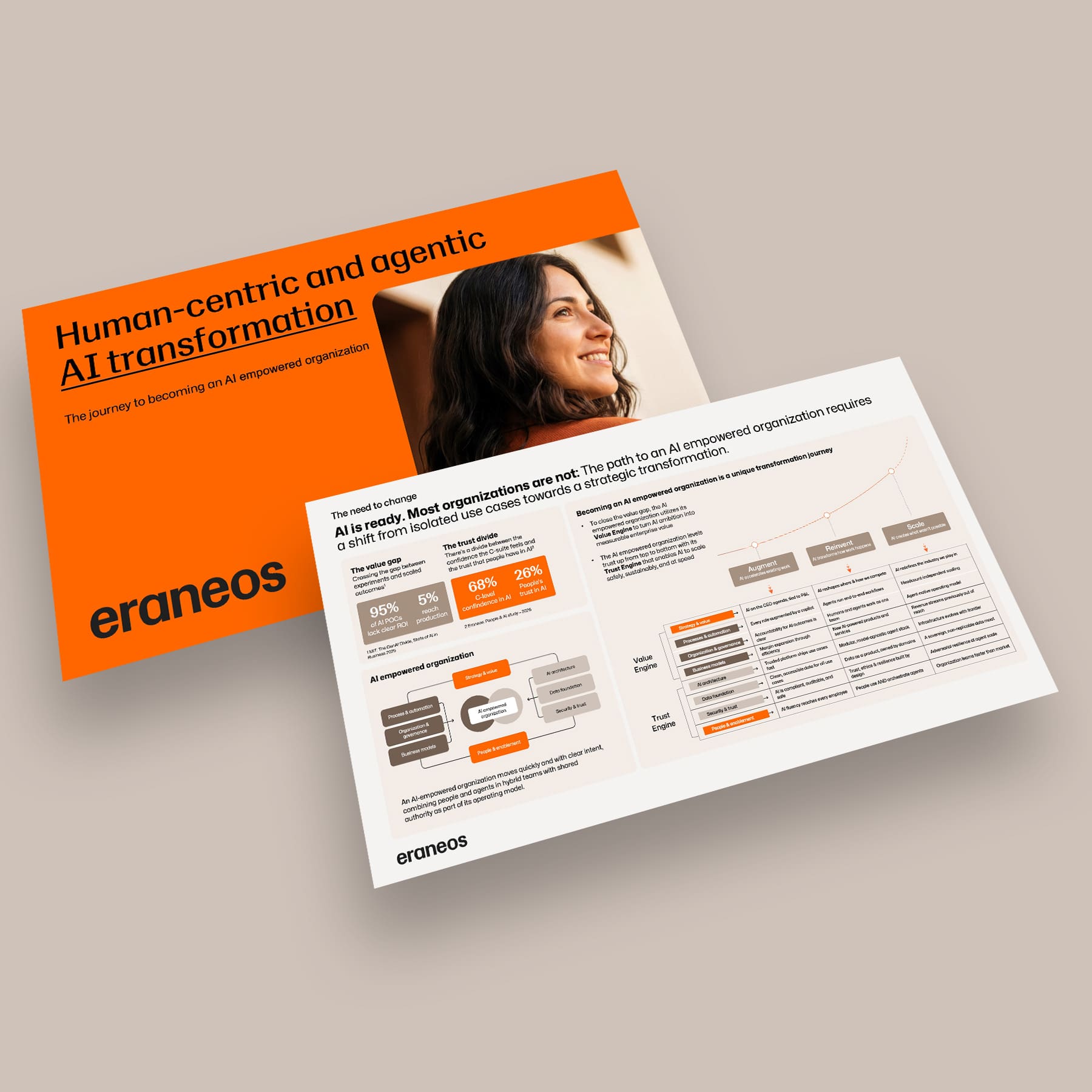
AI is ready. Most organizations aren't.
AI initiatives rarely fail because of technology. They stall when organizations aren’t ready to operate in new ways. Learn how we help leaders redesign how work happens.

Unique conditions – and unique opportunities
Question: What does this transformation mean specifically for a highly regulated, safety-critical sector like the energy industry?
Felix Schwerin:
“Regulation will shift from retrospectively approving individual projects to actively shaping AI-based system management. Early discussions on AI standards for critical infrastructures and the EU AI Act suggest that by the 2030s, admission processes, audit trails, and real-time algorithm monitoring will be as standard as today’s grid security calculations.”
Claudia Schulze:
“At the same time, energy companies have a significant advantage thanks to the high availability of structured measurement, load, and market data. Organizations that treat this data as a strategic asset early on – including synthetic data for rare extreme events – can develop robust AI models capable of simulating grid disturbances, extreme weather, or congestion markets before they occur.”
Dr. Marko Sarstedt:
“This could also reshape the notion of compliance: Not just ‘Are we allowed to do this?’ but ‘Are we obliged to use the available intelligence to reduce system risks?’ Once autonomous grids demonstrably lower outages and emissions significantly, questions about the neglect of AI use will arise.”
Technology, trust, and new role models
Question: If the technology is manageable, what do organizations need to fundamentally change in the coming years?
Claudia Schulze:
“We will see a new generation of operating models where AI decisions initially run alongside human-driven ones, then gradually co-decide, and eventually act autonomously within set limits. Transparent models, explainable forecasts, and well-defined escalation paths are critical for this – otherwise, trust will erode, especially in safety-critical areas.”
Dr. Marko Sarstedt:
“Research shows that people accept algorithms when they understand their strengths and limitations, and when feedback loops exist. Successful companies therefore embed AI not as a ‘black box’ but as a collaborative partner: through training that enables employees to question, improve, and build trust in model decisions.”
Felix Schwerin:
“Culturally, this means moving away from silos of ‘specialized departments vs. IT’ toward product-oriented teams composed of data scientists, grid or sales engineers, and regulatory specialists. In ten years, the most visibly successful energy providers will be those that integrate AI competence not as ad-hoc hires but into their organizational DNA.”
2035: A view on a mature AI-centric company
Question: Looking ahead 10–15 years – what might a typical picture look like?
Claudia Schulze:
“Many processes will no longer be perceived as ‘AI use cases’ but as standard business operations: Grid control centers will work with digital twins that simulate every topological change and large consumers like data centers in real time. Generative AI automatically creates operational instructions, reports, maintenance plans, or regulatory filings – humans intervene only on exceptions, edge cases, and strategy.”
Felix Schwerin:
“We will see an energy market where AI shapes both supply and demand: On one side: intelligent data centers with dynamic load shifting. On the other:, households and industrial clients whose flexibility is automatically integrated into portfolios. The competitive advantage will then stem less from individual algorithms and more from the ability to build ecosystems of partners, data, and platforms.”
Dr. Marko Sarstedt:
“Perhaps the attitude-behavior gap will have narrowed somewhat by then – not because people ‘believe in AI’ more, but because they experience daily that an AI-supported system runs more stably, efficiently, and sustainably than the old one. The intriguing question will then be: How do we shape the next level of human-AI collaboration, beyond mere automation?” The energy industry is at a turning point: Over the next decade, the industry will determine whether AI remains primarily a subject for glossy presentations – or becomes the invisible nervous system of a predominantly renewable energy system. Companies that build data foundations, MLOps platforms, governance mechanisms, and the right capabilities today are laying the groundwork for the decade ahead. By 2023, AI won’t just drive efficiency, it will be central to supply security, climatetargets, and entirely new business models.