AI is no longer an experiment. Across European organizations, it is becoming infrastructure, increasingly embedded in daily operations and consequential to decision-making. Yet for most, the ROI remains elusive. Tools have been deployed, investments made, adoption dashboards are climbing. But the organizational work has not kept pace with the technology investment. Governance is only partial, accountability is implied rather than defined, while capabilities are built through methods that do not transfer into daily judgment. AI has been layered on top of existing processes while workflows, decision-making, and accountability stayed unchanged. Three out of four organizations across Europe are not getting transformative value from AI, and most current programs are not designed to address that.
The illusion of progress
The Eraneos People & AI study was built to measure the gap between AI ambition and reality. Our research captures the same organization from five seniority levels simultaneously: C-level executive, director, senior manager, manager, and frontline specialist. With the use of 19 indicators, it covers three core dimensions – AI adoption, AI capabilities, trust & governance – revealing not just how much AI organizations are running, but whether the conditions for it to produce value have actually been built.
"The critical question is no longer whether an organization uses AI. It is whether leadership is prepared to redesign how work, decisions, and accountability actually happen. Without that shift, AI adoption becomes noise - visible on dashboards, but invisible in performance."
Key findings
The People & AI Study 2026 gives European leaders the data to diagnose where their program is breaking down, and a clear framework for what to build instead. The organizations pulling ahead are not running more AI. They have built the governance, accountability, and embedded capability that make AI output trustworthy and acted on. Our research identifies four key findings:
- Leadership is misreading reality. C-level executives are on average 2.3 times more likely than frontline specialists to describe their organization positively on every dimensions we tested. The gap is widest on trust in AI, where it reaches 47 percentage points. The leaders best positioned to fix the problem are the least likely to see it.
- Adoption is a vanity metric. Only 7% of organizations see significant AI impact across every dimension measured, despite AI touching 39% of daily operations on average. Adoption and value are structurally decoupled. The differentiator is not how much AI you run. It is what you have built around it.
- Trust breaks in the last mile. 74% of respondents discard at least 40% of the AI recommendations they receive. The cause is not accuracy. It is the absence of clear guidance and defined accountability. Where guidance is clear and widely known, the number falls to 54%. Where there is high confidence and trust in AI, it falls to 47%.
- How you build AI capability matters as much as whether you build it. Frontline confidence reaches 56% where AI is embedded in daily workflows, versus 15% with standalone training. Employees with high confidence in AI also give their employer an NPS of +91, compared to +26 for those without it.
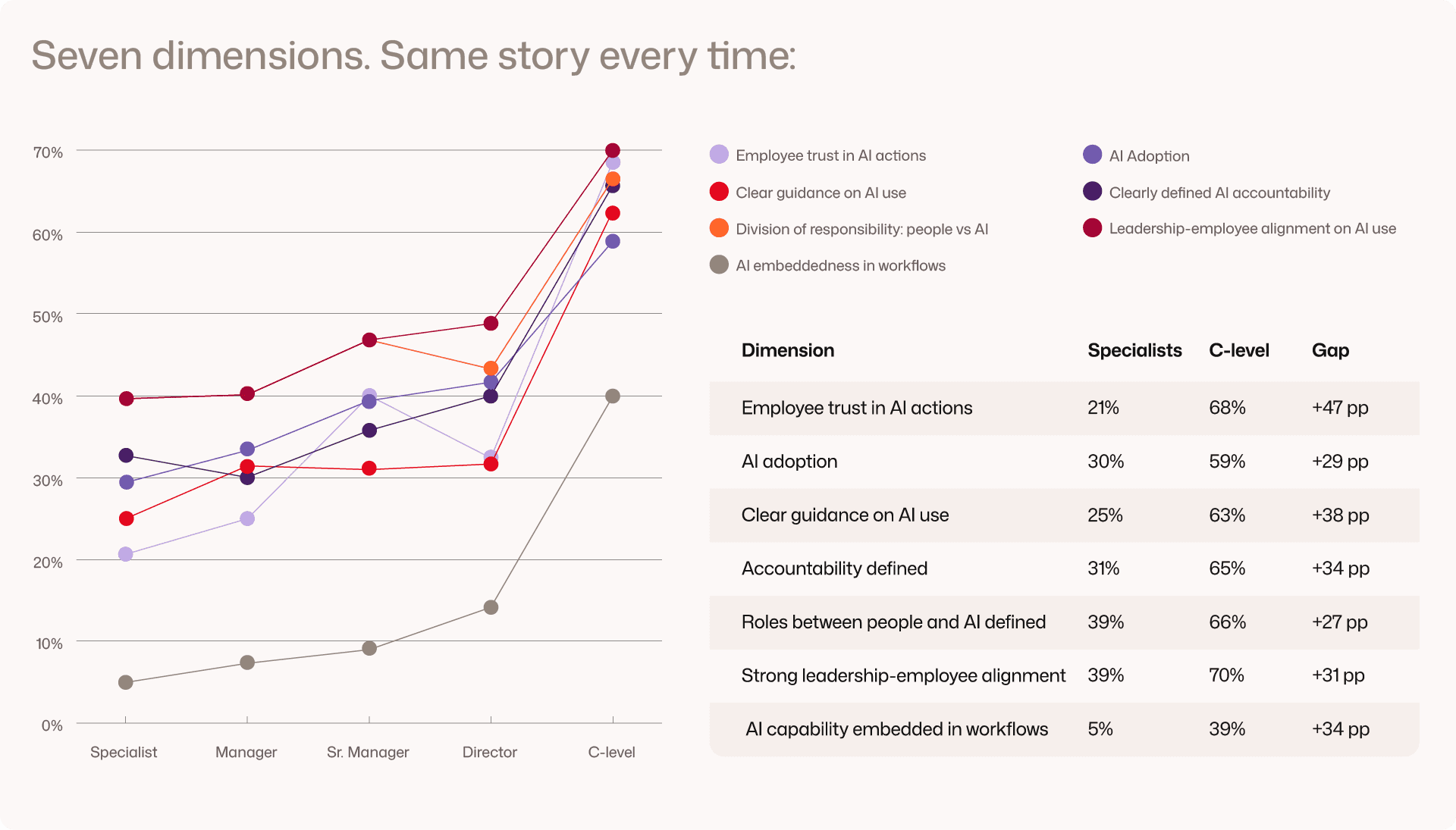
Leadership and (senior) specialists AI gap
The People & AI study gives European leaders the data to diagnose where their program is breaking down, and a clear framework for what to build instead. The organizations pulling ahead are not running more AI. They have built the governance, accountability, and embedded capability that make AI output trustworthy and acted on. If your organization is investing in AI and not yet seeing the returns, this research shows why, and where to start.