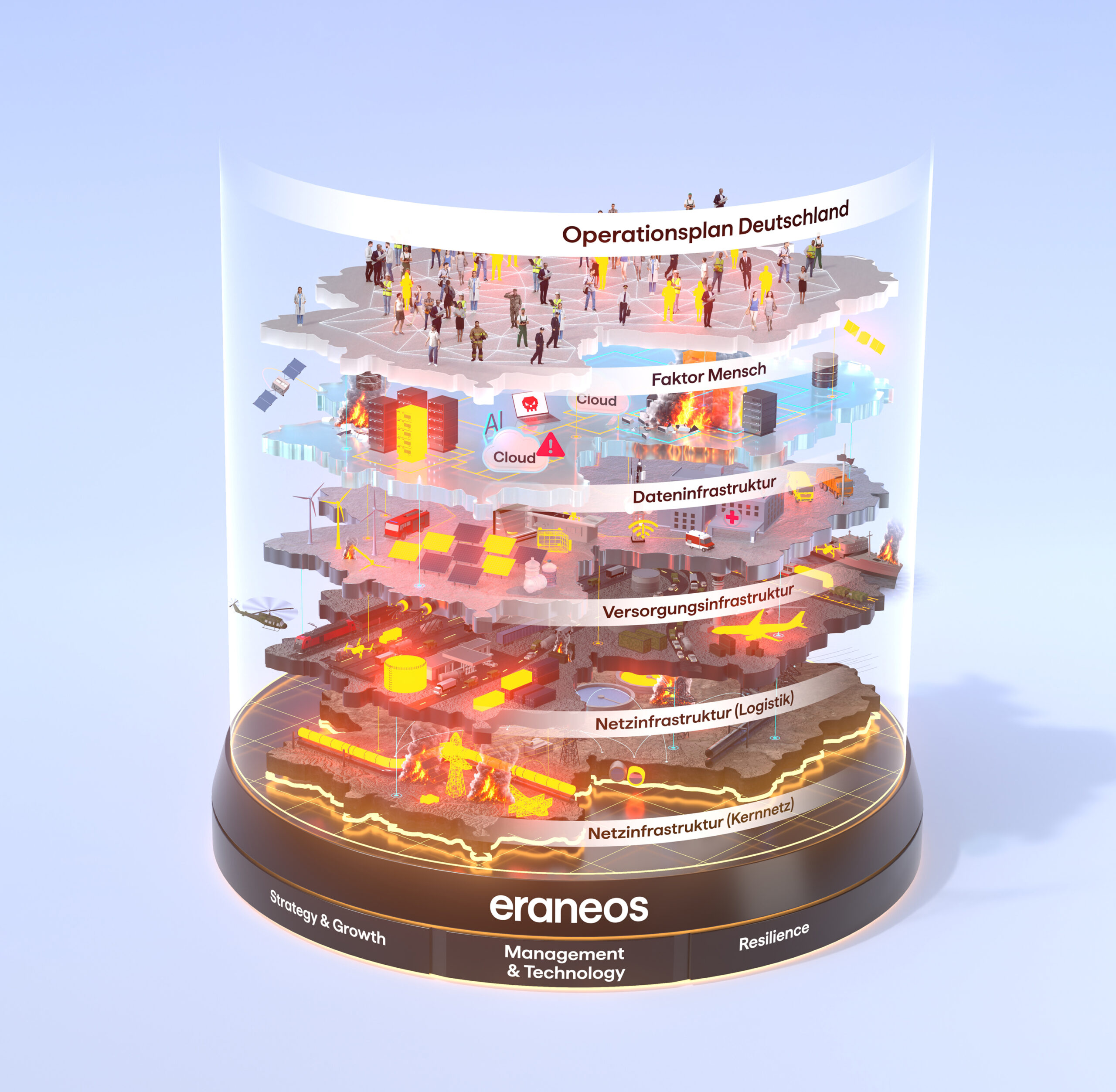
With the Operational Plan for Germany (OPLAN DEU), the role of the German economy is shifting towards the core of the national security architecture. Critical infrastructure is therefore no longer just part of essential service provision, but an integral element of national defence readiness. For the C-suite, this means resilience has become a strategic leadership priority, with a direct impact on business models, stability and competitiveness.
The greatest risks arise between systems
Whether in energy, logistics or data infrastructure, the most critical vulnerabilities do not lie within individual systems, but at their interfaces. It is precisely here that an organisation’s ability to function in a crisis is determined. Companies must understand and actively shape their role within the wider system through clear governance and accountability at the highest level. Bodo Forstmann, Managing Partner Eraneos Germany, emphasises: “At Eraneos Germany, we see it as our clear responsibility to actively safeguard the resilience and competitiveness of our clients’ business models. This enables them to manage risks more effectively, fulfil their role in the critical infrastructure context and contribute to national security.”
Resilience as a strategic component of defence readiness
The Operational Plan for Germany makes one thing clear: economic stability is a central pillar of national security. Companies that embed resilience strategically not only protect their operational capability, but also make an active contribution to the defence readiness of the state as a whole. This requires a clear understanding of their own role, capacities and dependencies. Stefan Pauly, Senior Counsel and Rear Admiral (Ret.), adds: “Many companies do not yet understand their dependencies well enough. In a crisis, this becomes a serious risk factor.”
Structures must hold up in an emergency
Defence readiness does not emerge on paper, but in day-to-day operations. Clear responsibilities, tested contingency plans and realistic exercises determine whether organisations remain capable of acting under pressure. Only when strategy, technology and operational processes work in close alignment can a resilient overall system be created. Dr Martin Schössler, Partner Defence, highlights a critical gap: “Many organisations have contingency plans in place, but very few put them to the test under realistic conditions.” Companies seeking to future-proof critical infrastructure in the context of the Operations Plan Germany therefore need a holistic view of strategy, governance and technology. The full advertorial shows how to secure your organisation sustainably and develop it strategically for the future.
Download the full advertorial free of charge today.
You are also welcome to contact our Eraneos experts directly to position your organisation in the field of critical infrastructure as effectively as possible.