
Utility companies are increasingly positioning themselves as orchestrators who implement complex energy projects for their customers. To do this, they must efficiently coordinate with manufacturers, installers, financiers and insurers while also providing seamless, all-in-one service experiences to business partners and customers. That’s why digital ecosystems are the key to their success.
Imagine a world in which machines communicate seamlessly, supply chains adjust in real time and companies anticipate customer needs before they even happen. For Germany’s energy providers, this is no longer a futuristic vision. They have been adapting for years, supported by the transformative power of digital ecosystems. They are rapidly gearing up for a new era of agility and connectivity. Unlike traditional, linear value chains, digital ecosystems are dynamic, multidimensional networks that promote collaboration, streamline processes and open new growth opportunities. As a result, they are accelerating the energy and heating transition and expanding the potential for energy providers to create value.
Digital ecosystems are now seen as key factors for innovation, efficiency and competitive advantage. By using digital platforms and seamlessly sharing data, companies are better equipped to align products with customers and partners. Energy suppliers who recognize this new potential are increasing their efficiency, reducing costs and even tapping into new sources of revenue. It is important to understand that a digital ecosystem is much more than a network of players. It is a dynamic, data-driven environment in which companies, customers, suppliers and tech providers work together to drive continuous innovation. Ignore this, and you risk falling behind and missing out on valuable growth opportunities for your company.
"We have built a digital platform that understands customers’ homes and energy goals as part of a streamlined, intuitive customer journey and turns them into end-to-end energy and heating solutions."
Why digital ecosystems matter in the utility industry
Digital ecosystems are central to B2C and B2B sales, helping shape the energy models that will drive the transition in the decades ahead. As energy systems become more decentralized, they increasingly connect assets such as solar panels, heat pumps, storage systems and charging infrastructure. In this environment, utility companies are evolving into orchestrators who implement complex projects for their customers while supporting ambitious decarbonization goals. To succeed, they need to collaborate efficiently with manufacturers, installers, financiers and insurers, while providing partners and customers with a seamless, all-in-one experience.
The backbone of energy-efficient ecosystems is a strong digital platform. It digitalizes every step of the process on both the customer and company sides and connects all supply partners in one place. In the German market, startups and established utilities alike are investing heavily in new technologies to raise the bar for business and process management. The platform also collects and bundles customer and partner data, giving artificial intelligence (AI) the foundation it needs to further develop services and unlock new opportunities for process optimization.
As head of regional energy supplier Badenova, Hans-Martin Hellebrand was one of the first German CEOs to oversee the creation of a digital ecosystem for his company’s residential customers. He says, “The energy transition isn’t just about infrastructure. It’s happening in people’s homes, driven by customers who want to actively shape a more sustainable future. The biggest challenge isn’t technology. It’s finding the right solution for each individual situation. That’s exactly where our ecosystem comes in. We’ve built a digital platform that understands customers’ homes and energy goals as part of a streamlined, intuitive customer journey and turns them into end-to-end energy and heating solutions. Behind the scenes, we coordinate a strong network of installers, technology partners, financial institutions, and insurers. For our customers, it all comes together as a seamless, all-in-one experience, even though it involves many different players. That’s how we make the energy transition personal, practical and scalable.” Hellebrand’s ecosystem vision brings together all the key dimensions for data-driven, customer-centric market development and scaling (Figure 1).
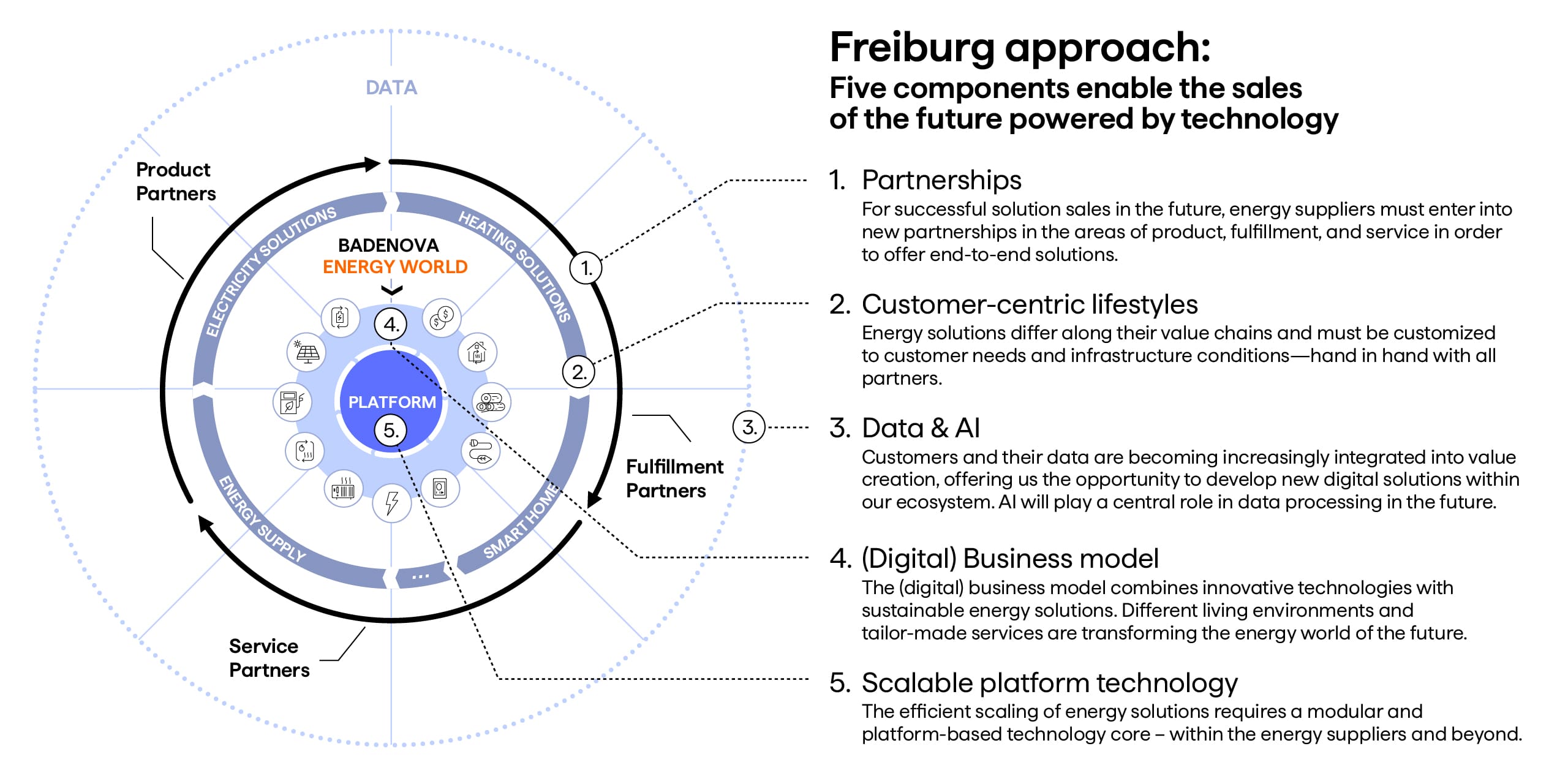
Figure 1. The Badenova approach: Five components that enable tech-driven sales
How utility companies benefit from digital ecosystems
When implementing digital ecosystems, it takes a holistic approach to make sure everything works together smoothly across your company’s value chain. This increases business value and sets you up for long-term scalability. Below, we cover the most important aspects to incorporate into your strategy.
Digital user journeys: Making it easy to do business with your company
The user journey is essential to any digital ecosystem strategy. Your customers expect your brand to act as a single entity. It’s important to live up to that expectation by offering them a seamless journey across all touch points. That means breaking down internal silos and keeping all departments aligned to offer a customer-centric user experience built on omnichannel integration, consistency and personalization. To keep things on track, monitor KPIs such as abandonment rates and Net Promoter Scores (NPS to spot roadblocks and continually improve the customer journey.
Technical foundation: Agile infrastructure
The right technology is crucial for delivering seamless user experiences. Modular architectures based on microservices, robust APIs and cloud infrastructures enable scalability, agility and adaptability. Centralized data architectures and modern development methods should also be part of your technical foundation to streamline development pipelines, leverage automation and enable rapid iterations.
The untapped potential of third-party partners
Third-party integrations bring your digital ecosystem to life. They promote joint development opportunities, expand the ecosystem’s value proposition and drive innovation. Building a comprehensive API layer enables partners and providers to integrate easily and securely. This unlocks the potential to create an integration marketplace that contains ready-made plug-ins or services such as payment providers, logistics solutions or analytics platforms that accelerate adoption. Choose providers and third parties based on how well they align with your company’s strategic goals and long-term vision for the digital ecosystem.
Building a strategy for sustainable change
To succeed, your digital ecosystems must align with your company’s strategic goals, governance, accountability and KPIs such as ROI and adoption rates. IT must work hand-on with business teams to make the right strategic decisions, so the system continues to add value and keep pace with market changes.
Conclusion
Building a digital ecosystem takes time and effort, but it is achievable. And every day, new success stories like the one at Badenova are emerging from across the business world. Now is the time for utility companies to take on this change and position themselves for long-term success. The following practical tips, drawn from real-life experience, can help guide your own digital ecosystem journey (Figure 2):
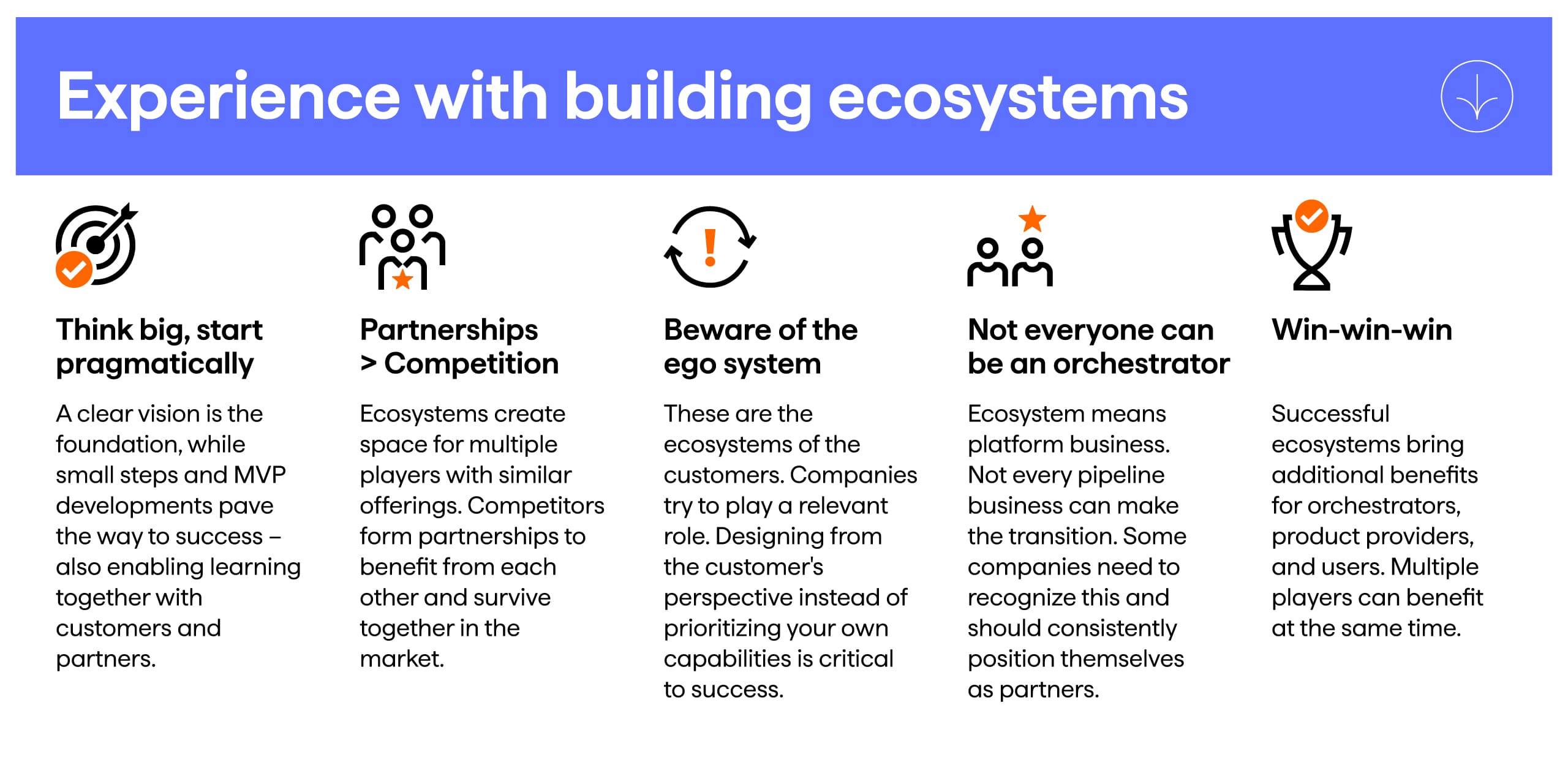
Figure 2. Lessons learned
- Think big, start small: A clear vision sets the direction, while small steps and MVPs move you forward and create space to learn together with customers and partners.
- Friendly competition: Ecosystems allow multiple companies with similar offerings to operate side by side. Even competitors can collaborate, share knowledge and create value together.
- Keep it customer-focused, not product-focused: Your digital ecosystem should belong to your customers. It should enable you to add more value for them. Start with your customers’ needs in mind, rather than your capabilities.
- Not everyone can be an orchestrator: Ecosystems rely on platform models. Not every traditional pipeline business can make that transition. Some companies need to recognize this and focus on positioning themselves as partners.
Or, as Hans-Martin Hellebrand says, “Think big. Grow step by step. Do it.”