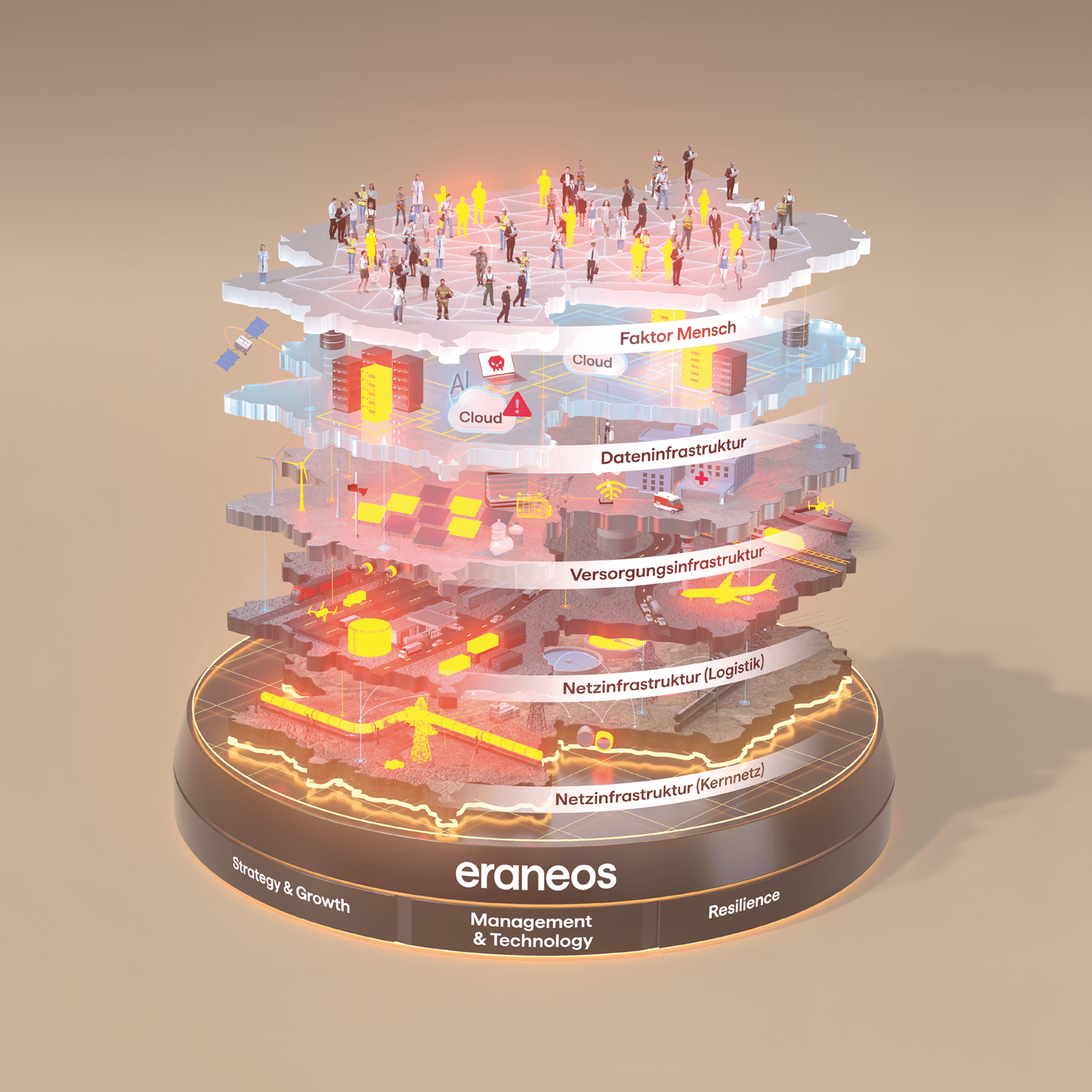
Germany’s critical infrastructures are under increasing pressure — and with them, the responsibility at the highest executive level is, too. What was long considered a technical or operational issue is increasingly evolving into a strategic risk with direct implications for value creation, competitiveness, and societal stability.
The greatest risks lie between systems
The most critical vulnerabilities often arise not within individual assets or applications, but at the interfaces between technologies, responsibilities, and data flows. This is precisely where clear ownership is required, along with management that can handle connectivity not only technically but also organizationally. Sergej Lietzenberger, Partner Management & Technology, puts it succinctly: “Security has long since become an economic factor.”
From a security issue to a business factor
In the critical infrastructure (KRITIS) sector, resilience no longer determines just security—it also impacts competitiveness, investment capability, and market trust. Companies that address the topic strategically create stable operating models and open up new opportunities for growth. Christian Wetter, Partner Strategy & Growth, emphasizes: “The availability of real-time data is becoming the key to new business models.” The full advertorial outlines the questions C-level executives should now be asking—and why integrated thinking is becoming a key success factor.
Engage with the topic and start the dialogue now
Anyone aiming to future-proof critical infrastructure needs a holistic view of strategy, governance, technology, and operations. This is exactly where Eraneos provides support. Michael Martin, Partner Resilience & Cybersecurity, explains: “Clear responsibilities, emergency plans, and training secure operations without slowing down innovation.”
Download the full advertorial now — free of charge.
You are also welcome to contact our Eraneos experts directly to position your company in the best possible way on the topic of critical infrastructure (KRITIS).