Hybrid threats have become a strategic reality for Germany, and civilian ports are emerging as particularly vulnerable hubs. They carry foreign trade, energy supply and industrial supply chains and, in an alliance defence scenario, military deployment capability. At the same time, they are highly digitalised ecosystems in which cyberattacks, GPS and AIS spoofing, sabotage, drones and shadow fleets increase their exposure. Nord Stream, severed Baltic Sea cables and the months-long outage of Estlink 2 make it clear that these incidents are not theoretical.
Regulation exists: the ISPS Code, NIS2 and, since January 2026, the KRITIS Umbrella Act. Yet each addresses only one dimension, while modern attacks combine several at once. In practice, resilience is held back by fragmented security concepts, unclear responsibilities between operators, federal states and the federal government, and the lack of a common operational picture. The numbers are clear. A one-week outage at Bremerhaven alone would put goods worth four to six billion euros at risk.
Effective port protection does not come from more site-by-site security. It comes from a connected operational picture. Our whitepaper shows how port operators, federal states and security authorities can integrate existing systems into a modular port protection system. It is vendor-neutral, builds on existing infrastructure and avoids costly parallel structures. The result is a common operational picture that detects threats early, speeds up response, relieves staff and safeguards minimum operations.
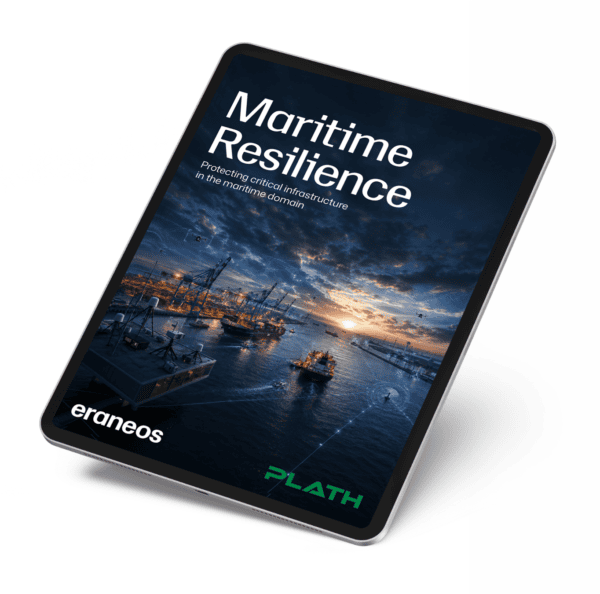
In the whitepaper “Maritime Resilience”, PLATH and Eraneos show how this gap can be closed without rebuilding the security architecture from scratch. The approach connects existing sensors, port IT, control centres and official reporting channels into a common real-time operational picture. Threats become visible earlier, responses get faster, staff are relieved and minimum operations are secured. The approach is vendor-neutral, modular and built on existing systems.
Download the whitepaper to learn how an integrated port protection system is built in four steps, from threat analysis to a proof of concept for your site.
In this whitepaper, you will learn about:
- The threat landscape and key indicators, from GPS interference over the Baltic Sea to the shadow fleet
- The three drivers of the security gap: heightened threats, fragmented concepts and unresolved governance
- National value at risk: what a port outage costs the economy, stage by stage
- A multi-layered security architecture spanning sensors, data fusion, operational picture and response
- Use cases from spoofing to passenger terminals
- Implementation in four steps, from threat analysis to proof of concept