


Artificial Intelligence (AI) has become a present-day force reshaping entire industries – and the energy & utilities sector is certainly one of them. As nations prioritize the security of energy supply, digitalization and AI are emerging as critical tools – complete with both risks and opportunities. In a recent study* in Switzerland on AI’s impact on energy & utilities, Eraneos investigated its profound effects on domestic and surrounding markets.
The AI opportunity: Optimizing power from generation to socket
Across the entire value chain of the energy sector, a wide range of opportunities can be identified which are illustrated in the below figure.
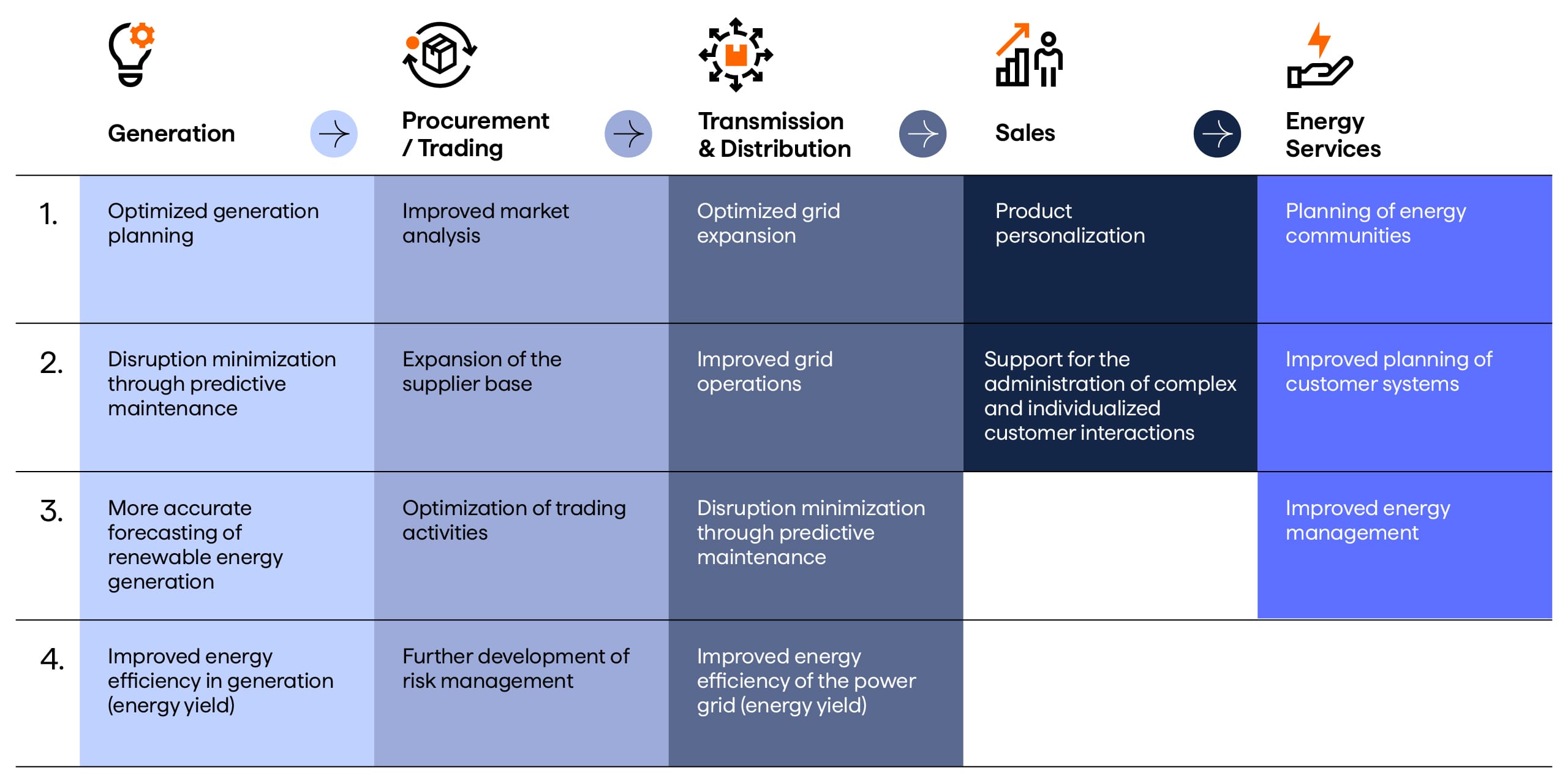
Based on the study, the areas with the most significant potential for boosting energy supply security are energy generation, transmission and distribution. AI models excel at processing vast, complex datasets such as SCADA/EMS/DMS signals, asset- and meter data, weather and market data. This makes them ideal for optimizing intricate systems. Examples include SAIDI and SAIFI metrics, balancing costs, reducing curtailment and unplanned outage minutes. AI models offer the potential for:
- Smart grids: AI can predict energy demand with greater accuracy, allowing grid operators to balance supply and consumption in real-time, integrating intermittent renewables, such as solar and wind, more smoothly.
- Predictive maintenance: AI can analyze sensor data from critical infrastructure (like power lines or turbines) to flag potential failures before they occur, enabling proactive repairs and drastically reducing unplanned outages.
- Trading efficiency: In energy markets, AI can identify patterns and execute trades faster and more strategically, securing necessary energy supplies and optimizing costs.
Our survey data makes the AI opportunity clear and is supported by other research. Another recent study by IBM found that 74% of energy & utilities firms globally have already implemented AI or are exploring its use in their operations. Applications are currently concentrated in trading and grid operations, highlighting the immediate value of AI in maintaining a stable energy supply.
The AI risk: A dual threat of consumption and security
While the benefits are clear, the path to AI integration is fraught with risks that require careful management, especially around critical sectors like energy & utilities. Perhaps one of the most cited risks in the study concerns AI’s increasing energy demands. Training the most powerful AI models, especially those used for generative AI, requires immense data center computing power, leading to a surge in electricity demand.
Even if the majority of the intensive training of AI models happens outside national borders, using pre-trained models on new datasets – a process known as “inference” – can still place heightened demand on domestic energy supplies. Although precise figures are often protected by data center operators, this remains a significant concern for national and European electricity grids. Greater transparency regarding energy consumption is urgently needed to inform regulatory planning in this area.
However, as the study findings demonstrate, there are far more and potentially greater risks that could arise from the use of AI for the energy supply system, as shown in the following Figure.
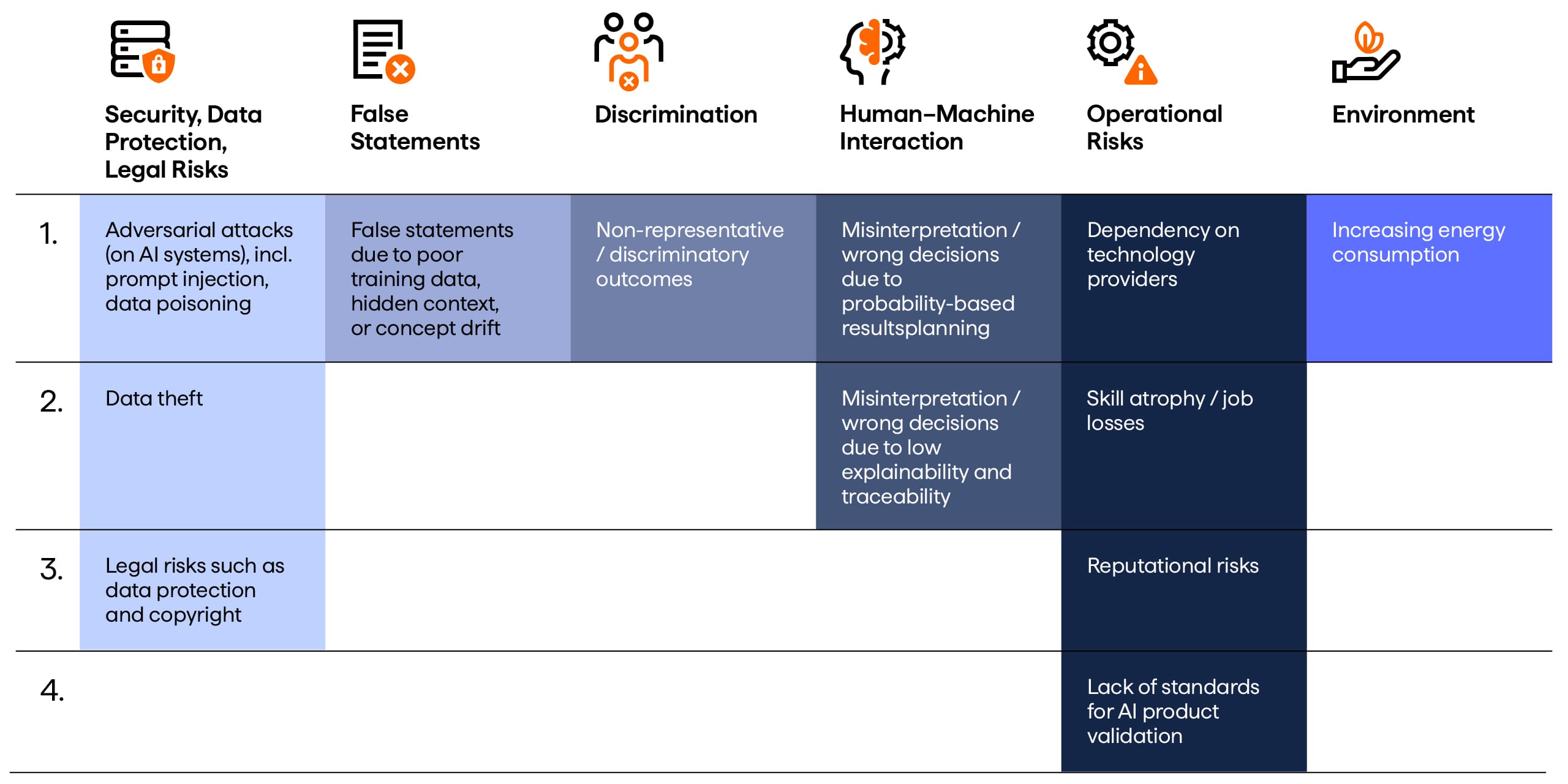
AI can both introduce new risks and amplify existing ones around energy supply security. Beyond the risk of system failure due to poorly implemented or “misaligned” AI, the cybersecurity risk escalates significantly. As AI systems become central to grid operations, the survey results highlight how AI energy infrastructure assets can become high-value targets among cybercriminals. As such, a sophisticated AI-powered cyber-attack could disrupt or cripple large sections of energy & utilities infrastructure.
It’s crucial to understand that not all AI-related risks directly threaten energy supply, but those that do must be met with targeted mitigation strategies and robust risk management programs. The challenge of securing critical assets in the age of AI, as well as reducing the technology’s energy footprint, is fundamentally a European grid issue, not just a national one, requiring cross-border analysis and cooperation.
The regulatory tightrope: Navigating a new frontier
The speed of AI innovation has outpaced legislation. Currently, AI use in the sector is governed by existing laws, including those around energy, electricity and data protection. However, a specific framework is urgently needed.
The key driver for future regulation is the EU AI Act. Since the act categorizes AI systems used in critical infrastructure (including energy & utilities) as “high-risk,” its requirements for governance, risk management and transparency will have a profound effect on energy supply companies due to its widespread reach.
Although individual countries are actively developing national approaches to AI, these can take substantial time to formulate. Given the rapid pace of technological development, this may not be quick enough. To ensure market alignment and smooth cross-border operations, establishing structures compatible with the EU AI Act is strategically advisable for the medium term.
The transition to a highly digitalized, AI-powered energy sector is complex. The challenge surrounds the implementation of a regulatory framework that maximizes AI’s power to secure and optimize energy supply without stifling innovation or exposing critical energy & utilities infrastructure to unacceptable levels of risk. This balancing act will define the resilience and sustainability of the future power grid.
Ready to seize the transformative opportunities presented by generative AI? Contact our team at Eraneos to see how working with a trusted AI partner can move you quickly from initial rollout to scaled innovation.
* The research study was conducted by Eraneos Switzerland and commissioned by the Bundesamt für Energie (BFE) of Switzerland. 110 energy companies, covering more than 80% of the Swiss end consumers, participated in the study. The study was conducted in 2024-2025.

Schmuel Holles
Energy & Utilities Switzerland, Partner